When I started this blog nearly three and a half years ago, I had no idea what to expect. It was a crazy time, equal parts terrifying and exhilarating. I was starting a business, starting a blog and walking into the unknown.
The CCC blog isn’t big by any means, but I’m so grateful. We hit 230 followers recently, and I want to say that I appreciate each and every one of you. Whether you’ve been here for years or months, I hope you find our content valuable.
Clearly Conveyed Communications exists to give brands a voice, but you give me a voice. Your questions, your interest, your likes and shares encourage me to keep writing and find others who can provide a unique voice and valuable content for you. Thank you to our awesome contributors!
Lately I’ve been thinking about the future of this blog and how we can continue to provide value to our loyal readers. You may see some changes, probably minor, in the coming months but we’ll continue to give you the latest news, updates and insight in the marketing, writing and social media arenas.
Thank you, loyal readers, for sticking by my — and CCC’s — side.
Best wishes,
Jaime
Let’s chat (on blogging, a new project or otherwise):
Does your email signature on your smartphone contain the following disclaimer?
Sent from [insert smartphone model here]. Please excuse misspellings, typos and grammatical errors.
Sorry, it won’t save you.
This post is being typed on a smartphone, but I don’t expect you to excuse any errors. In fact, I’m embarrassed when I spot an error, even a minor one, in an old post.
Today, even in our 24/7, hyper charged world, grammar matters. Why?
1) It impacts your credibility.
Want to be a thought leader or subject matter expert? That’s hard when people struggle to read your thoughts. No matter the subject, readers will judge you for misspelled words and missing punctuation, which will change the conversation from what you had intended. Keep the focus on your knowledge, so you can impress.
2) Bad grammar makes you look unprofessional.
Go ahead: submit a resume, cover letter or business proposal with grammatical errors. You probably won’t be receiving good news. Business emails, texts and letters also reflect on you, so take time to proofread. It could be the difference between a thriving partnership or career and a missed opportunity.
We live in a digital world, so businesses need to get social to survive—and thrive. Customers, fans and prospects won’t share your posts if they’re chock full of grammatical errors. Already this week, I’ve been disappointed to see major grammar gaffes in posts I wanted to share, so I refrained. Lost advertising and missed opportunities don’t help businesses grow.
4) Bad grammar is bad for business.
In a recent Grammarly poll, 63% of respondents said they would hesitate to buy a product with grammatical errors. Several respondents even gave examples of what products they have passed up due to poor spelling or punctuation. Think about it. Wouldn’t you wonder about the quality of a product if there was a noticeable spelling error or poor grammar?
But I’m not a writer, you say. The fact is that most business professionals write more than ever today for the company blog, your LinkedIn profile or even an online portfolio. And that doesn’t even scratch the surface of emails, social media and other communication.
So take some time to understand the writing process or find someone to handle it for you. Don’t laugh; it’s no different than taking your car to a mechanic to have it repaired or hiring an accountant to mind your business finances.
You’ve poured blood, sweat and tears into perfecting your craft. Don’t ruin it with bad grammar!
%$#^%#$&%
p.s. If you’re looking for a professional to craft your prose, or even spruce things up, we’d love to help! Not sure what you need? Let’s talk. We’ll be happy to answer any questions you have on the wonderful world of writing.
Your writing pro,
Jaime
Let’s chat (on grammar, writing, a new project or otherwise):
Gossip is a dirty word. It’s condemned by parents, community leaders and business professionals the world over. Yet, here’s an interesting tidbit: it’s essential to our way of life. What?!
“Even today the vast majority of human communication — whether in the form of emails, phone calls or newspaper columns — is gossip. It comes so naturally to us that it seems as if our language evolved for this very purpose.”
In Sapiens: A Brief History of Humankind, Yuval Harari, PhD, argues that Homo sapiens (that would be us!) survived and even thrived when other human species failed due to our unique language capabilities, including the ability to gossip.
It’s not as crazy as you may think. When you break it down, gossip is conversation about other people. Who to trust, who has the best fresh vegetables and who is unsavory. As a small business owner, I want to know about a customer of other businesses who doesn’t pay their bills or a potential business partner who doesn’t know what ethical means. That’s knowledge that may save me lost revenue, lost time and serious aggravation down the road.
“The new linguistic skills that modern Sapiens acquired about seventy millennia ago enabled them to gossip for hours on end. Reliable information about who could be trusted meant that small bands could expand into larger bands, and Sapiens could develop tighter and more sophisticated types of cooperation.”
It’s similar to the proverbial ‘water cooler’ in the office. You may not want to get involved in office politics but that decision can derail your career. How often do employees label a manager or supervisor aloof or out of touch when he or she doesn’t have a beat on the pulse of the office? You need to know what’s going on — to some extent — in your coworkers’ and employees’ lives. As a business owner, I would even extend that to business partners and clients. It allows you to understand a situation, show empathy and act appropriately.
Is Gossip Good for Business?
Are you familiar with the gossip theory (in relation to evolution)?
Have you been affected by office politics — positively or negatively?
Is gossip good for business?
p.s. Sapiens: A Brief History of Humankindis a great read for history buffs and business professionals alike. Want an inkling into what makes people tick? You’ll get it here. Both quotes in this post are from this book.
p.p.s. Love this post’s featured image? Learn more about “Gossip Girls” by Art G. here. It’s used under a CC BY 2.0 license.
Cheers,
Jaime
Let’s chat (on gossip, business, a new project or otherwise):
CCC is honored to accept the Sunshine Award from Ahh the Simple Life! It’s an award one blogger gives to other bloggers “who are positive and creatively inspire others in the blogosphere.” Carol Preibis, co-founder of Ahh the Simple LIfe, is a contributor to the CCC blog and also recently published an eGuide, Living a Good Life: Live a Meaningful, Happy and Fulfilling Life, which we reviewed here. Check it out!
Are you living a good life?
Read Ahh the Simple Life’s nominating post (and learn more about Carol!) here.
*** How does the Sunshine Award work? ***
Upon nomination, bloggers accepting the Sunshine Award should:
thank the nominating blog and answer the questions it posed
nominate other bloggers
ask the bloggers you nominate the same number of questions as you received
notify the bloggers you have nominated
*** Ahh the Simple Life Asks and CCC Answers ***
1) Why did you begin blogging, and what keeps you going?
It’s been a strange and wild ride, but we hope you’ve enjoyed the journey. Sometimes we wonder what kind of impact we’re making, so it’s always refreshing to hear from you!
2) What is your favorite topic to write about?
Although the diversity of the CCC blog seems to be a big draw, I love to write, even about writing. Maybe especially about writing. Our series on the writing process is my favorite series to date on this blog.
My favorite series on the CCC blog is about the writing process. Have you read it?
3) What is your favorite inspirational film?
While Rocky’s victory over Apollo Creed is the epitome of the classic underdog story, I love Field ofDreams.(We even blogged about it, in relation to blogging of course.) Not only does this movie focus on baseball, it’s message of being selfless and following your dreams still resonates today.
Let’s face it: some people will think you’re crazy for following your dreams, and listening to a voice in your cornfield ranks right up there.
My favorite inspirational film outside of the sports world is Goodwill Hunting.
4) How would you describe your perfect day?
My perfect day would begin when I wake up naturally, no alarm in sight. After taking in the amazing view, I’d saunter downstairs to brew some espresso for a delicious, handcrafted latte, which I’d enjoy with fresh fruit and peanut butter on toast. The rest of my perfect day would be spent reading, writing and enjoying nature, via a trail run or hike. After a vigorous swim (and maybe some paddle boarding), we’d grill some mouth-watering fish for dinner and sit around the fire, toasting s’mores and telling stories.
5) What is the greatest challenge facing humanity today?
While our challenges are numerous, so many come back to the massive (and growing) income inequality problem. It’s disturbing how quickly people label someone not firmly upper middle class as lazy or ignorant (or both). Teachers, social workers and entrepreneurs may be some of the hardest-working people you meet, but their skills aren’t valued in our society nearly as much as professional athletes and rock stars. (No, all entrepreneurs aren’t Elon Musk or Mark Zuckerberg.) It’ll be interesting to see how this issue affects all of us in the coming years.
6) If you could travel anywhere on the globe, where would you go?
I would love to travel nonstop, experiencing other cultures and traditions, although I would make Italy (or a tropical island) my home base. I’ve long been interested in exploring my Italian roots, and I love water. Someday, I’ll wake up to a beautiful water view.
*** 6 Questions for CCC’s Nominees ***
What did you want to be when you were growing up?
What activity makes you happy?
What’s your favorite song, and why?
What’s one thing that you have learned this year?
Who has been a mentor, role model or hero at any time during your life?
What’s something that your blogging audience doesn’t know about you?
While our nominees are under no obligation to acknowledge or accept their Sunshine Award, we’re grateful of what they bring to the blogosphere. Take a few minutes to visit their blogs and explore what makes them tick. We think you’ll be glad you did.
Congratulations to our nominees, and a heartfelt thank you to Carol Preibis at Ahh the Simple Life for the nomination. One of the biggest blessings of blogging is the fellow bloggers that you meet, and Carol is at the top of my list.
We’d also like to thank our loyal readers! Without you, we’d be writing to ourselves in a public forum. We hope that you continue to find our content valuable and take a moment to drop us a note once in awhile. In turn, we’ll keep on keeping on trying to educate, inform, entertain and inspire.
Cheers,
Jaime
Let’s chat (on sunshine, blogging, dancing in the rain or otherwise):
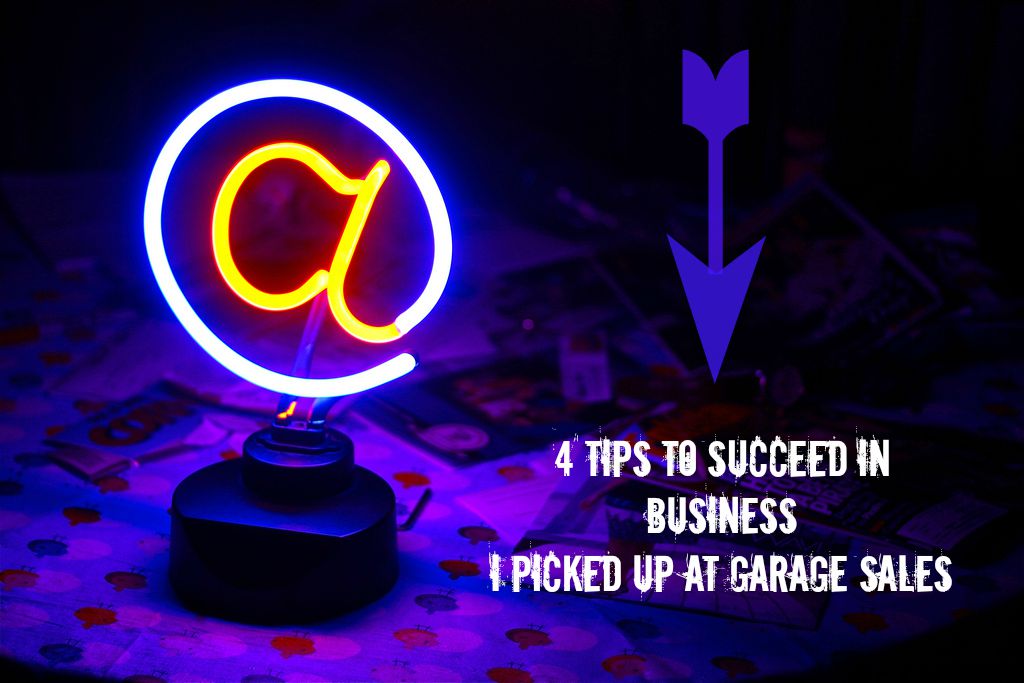
Four years ago, my family and I decided to host a multi-household garage sale. It was a great opportunity to pass on some of our lesser used wares and get together (mostly the latter). Of course, I decided to dig deeper to get the most out of our time and efforts. I was surprised by what I found.
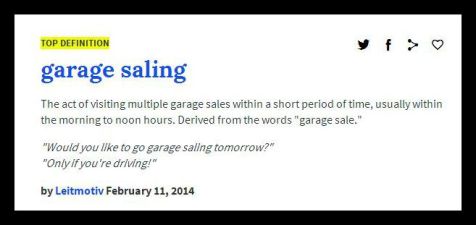
‘Garage saling’ (or sailing) is a thing. There are people who plan their weekends (or day trips) around hitting garage sales and discovering hidden treasures. (Note that I have various hobbies that people find weird, so I’m not making fun of anyone here.) As I dug deeper, I discovered that serious garage salers (or sailors) handle their business like a business.
Here’s what I learned from them that you can use to succeed in business:
Have a plan: Garage salers like to browse the Friday paper’s Classified section to form a plan. Are some areas hosting multiple sales? Are they looking for specific items? There are a number of websites that promote garage sales now too, although I’ve received a bigger return on investment advertising in the local paper.
Know where your audience is, so you can target your marketing efforts. You’ll receive a larger ROI for your efforts.
Trust your gut: While serious garage salers have a plan, they also improvise. Maybe they pass a sign for another sale (or great local cafe) and decide to make a detour. You never know what you’ll find when you open yourself up to new experiences.
Planning for your business is necessary, but so is adaptation and flexibility. Because life and business rarely go according to plan…
Know when to negotiate: People think that garage salers like to negotiate everything. Selling something for 50¢? They’ll want it for a quarter. That’s not true, at least from my experience. Serious garage salers know when to negotiate and when to save their time and energy. Antique furniture? Let’s talk. An almost-new travel mug for 50¢? Consider it sold.
Don’t be an amateur. Know when to negotiate! Think value, not cheap.
Get your timing down: I would love to steal a line from our garage sale ads for my business meetings: “No early birds, please.” While the early bird may get the worm, people who show up at garage sales during setup get a cold shoulder and a frown. No, we have no idea where the [insert item from ad] is right now, but we’ll know in a half hour when we open for business.
If showing up for a business meeting 5 minutes early is ‘on time,’ then showing up 30 minutes early is unprofessional, not impressive.
In summary, have a plan but trust your gut. Know when to negotiate and when to save your time and energy. Be on time but don’t be excessively early. It’s amazing what you can learn about business from life when you open your eyes and take a look around.
Are you a serious garage saler (or sailor)?
What other tips would you add for successful garage saling (and business)?
p.s. The Shine Family Garage Sale has become an annual tradition. If you’re in the neighborhood tomorrow, stop on by!
p.p.s. Learn more about the awesome featured image for this post here.
Garage Sale Hostess with the Mostess,
Jaime
Let’s chat (on garage saling, business or otherwise):
The Man. Big Brother. The eye in the sky. Whatever you call it, it’s watching you. (Cue The Police — the band, that is.)
We’ve touched on the issue of privacy in a digital world before, but it’s worth revisiting as technology continues to improve. The issue comes from balancing convenience and maintaining any privacy whatsoever. Where’s the line in the (digital) sand? When will we know when it has been crossed?
“It straddles the line of creepy and cool.” –Jeff Bakalar, CNET Senior Editor
As CBS News reported, the new Google timeline tracks — and archives — every move you make. Before you completely freak out, note that your timeline is visible only to you, and the search giant does allow you to opt out of being tracked. Of course, that may hinder any location-based services you utilize, such as Google Maps.
Understand that this isn’t a Google issue, or a Facebook issue; it’s a human issue. Do we jump all in to utilize the conveniences that technology offers? Do we maintain any privacy at all? Does it matter anymore?
Sure, you can opt out of the Internet entirely, but that’s getting harder and harder to do. According to a Pew Research study released last week, 15% of American adults don’t use the Internet at all. While that’s a substantial drop from a 2000 study (48%), it’s still shocking to most of us. How do they manage? What do they do for a living?
“In our ever-more wired world, connectivity is crucial for access to jobs, government services, health care, and information—as well as for the education and skills training of younger Americans.” –Julia Greenberg, WIRED staff writer
So the question is where’s your line? Do you have one? Have you thought about it?
There’s no right or wrong answer here. It’s a personal decision like what you wear or the music you listen to.
Let’s discuss; weigh in with your opinion. Where’s your line?
p.s. If you’re now humming “Every Breath You Take” by the Police, here you go. Enjoy!
An old school soul living in a digital world,
Jaime
“A number of Fortune 500 companies, including Google, AOL, Apple and Aetna, offer meditation and mindfulness classes for employees — and the top executives of many major corporations say that meditation has made them better leaders.”
In her article “The Daily Habit Of These Outrageously Successful People,” Huffington Post senior writer Carolyn Gregoire presents 10 influential business leaders who say meditation has helped them achieve (and sustain) a high level of success. The list includes Arianna Huffington, President & Editor-in-Chief, Huffington Post Media Group. Huffington has brought meditation into her company, offering weekly classes for AOL and Huffington Post employees.
Let’s take a look at some mindfulness practices that are being integrated into workplaces.
Jeremy Hunter’s Article
In this terrific infographic, “Your Mind at Work,” Jeremy Hunter teaches us “new ways to approach those niggling challenges in the office.”
Jeremy Hunter serves as Assistant Professor of Practice at the Peter F. Drucker Graduate School of Management at Claremont Graduate University. A PDF version of his article, “Is Mindfulness Good for Business?” may be downloaded here. The article first appeared in the premiere (April 2013) issue of Mindful.
Breathing Exercises
There are a number of different simple breathing exercises that can be done virtually anywhere.
This exercise is utterly simple, takes almost no time, requires no equipment and can be done anywhere. Although you can do the exercise in any position, sit with your back straight while learning the exercise. Place the tip of your tongue against the ridge of tissue just behind your upper front teeth, and keep it there through the entire exercise. You will be exhaling through your mouth around your tongue; try pursing your lips slightly if this seems awkward.
Exhale completely through your mouth, making a whoosh sound.
Close your mouth and inhale quietly through your nose to a mental count of four.
Hold your breath for a count of seven.
Exhale completely through your mouth, making a whoosh sound to a count of eight.
This is one breath. Now inhale again and repeat the cycle three more times for a total of four breaths.
Note that you always inhale quietly through your nose and exhale audibly through your mouth. The tip of your tongue stays in position the whole time. Exhalation takes twice as long as inhalation. The absolute time you spend on each phase is not important; the ratio of 4:7:8 is important. If you have trouble holding your breath, speed the exercise up but keep to the ratio of 4:7:8 for the three phases. With practice you can slow it all down and get used to inhaling and exhaling more and more deeply.
This exercise is a natural tranquilizer for the nervous system. Unlike tranquilizing drugs, which are often effective when you first take them but then lose their power over time, this exercise is subtle when you first try it but gains power with repetition and practice. Do it at least twice a day; you cannot do it too frequently. Do not do more than four breaths at one time for the first month of practice. Later, if you wish, you can extend it to eight breaths. If you feel a little light-headed when you first breathe this way, do not be concerned; it will pass.
Once you develop this technique by practicing it every day, it will be a useful tool that you will always have with you. Use it whenever anything upsetting happens — before you react. Use it whenever you are aware of internal tension. Use it to help you fall asleep. This exercise cannot be recommended too highly. Everyone can benefit from it.
Walking meditation is one of the simplest meditation practices, and ideal for workplace breaks.
“Walking meditation is practicing meditation while walking. It can bring you joy and peace while you practice it. Take short steps in complete relaxation; go slowly with a smile on your lips, with your heart open to an experience of peace. You can feel truly at ease with yourself. Your steps can be those of the healthiest, most secure person on earth. All sorrows and worries can drop away while you are walking. To have peace of mind, to attain self-liberation, learn to walk in this way. It is not difficult. You can do it. Anyone can do it who has some degree of mindfulness and a true intention to be happy.”
The Meditation Freedom podcast contains “interesting interviews with long-time practitioners, teachers, authors, and other folks with longtime meditation and mindfulness practices.”
I highly recommend “MF 26 – How to Easily Bring Meditation into Your Workplace!“. The author shows you “how you can incorporate ‘mini’-meditations and mindfulness at your place of work, without having to look weird, or needing a, ‘meditation room’.
Drew Hansen’s Guide
Forbes contributor Drew Hansen has given us a wealth of information in his article “A Guide To Mindfulness At Work“. Hansen has brought together ideas and resources from many different sources, and the content includes several useful links.
Introducing mindfulness into your workplace can be a simple, gradual process.
The benefits to the individual, the workplace, and humanity are immeasurable!
This is part two of a two-part series, Mindfulness in the Workplace, by Carol Preibis of Ahh The Simple Life. You can read part one here. If you’re a regular reader of the CCC blog, you’ll recognize Carol as a contributor. Thanks, Carol!
Carol is passionate about food, recipes and cooking.
Carol Preibis and her sister Michele value the Simple Life and want to help you shed the complicated nature of today’s world. They share insights on food, decorating, stress relief and living more simply, while actually enjoying day-in, day-out living. [UPDATE: Their blog, Ahh the Simple Life, is no longer active.]
There has been rapid growth in workplace mindfulness programs, and there are some compelling reasons why this is a good thing!
Meditation Meditation, glorious morning in the forest of Campana in Nettuno
“The enormous benefits of mindfulness at work are increasingly being recognized by employers as well as by employees. More mindfulness means more professional productivity and satisfaction, and less absenteeism, `presenteeism’ (where workers are physically present but unproductive), accidents, and workplace stress and the many psychological and physical problems that this causes. Mindfulness improves our work performance and enjoyment because it improves our decision-making ability, the quality of our working relationships, and our leadership.”
— Dr. Stephen McKenzie, author of Mindfulness at Work
What Is Mindfulness?
According to Jon Kabat-Zinn,”mindfulness means paying attention in a particular way; on purpose, in the present moment, and non-judgmentally.”
You do not need to meditate to become mindful. Meditation is a tool to lead people to post-meditative mindfulness. However, as you’ll see, much of the research focuses on meditation.
How Does Mindfulness Work?
Mindfulness actually works by changing our brains! That’s what’s behind the impressive benefits of mindfulness!
Richard Davidson is the founder of the Center for Investigating Healthy Minds at the University of Wisconsin-Madison. A major aspect of the center’s research is neuroplasticity—the ability of the adult brain to change its structure or function in an enduring way. Specifically, 1) You can train your brain to change, 2) that change is measurable and 3) new ways of thinking can change it for the better.
“The implications [of mindfulness in the workplace] are enormous. When you are mindful, you end up healthier, you end up happier. So, with an increase in mindfulness in the workplace, there is lower absenteeism, fewer healthcare costs and there is a reduction in accidents.”
— Ellen Langer, “The Huge Value Of Mindfulness At Work: An Interview With Ellen Langer“
Health
Meditation has some substantial health benefits, including reducing blood pressure, pain response, stress hormone levels and even affecting cellular health. For a look at what it actually does to the body, see this Huffington Post infographic.
In her article “Rewiring Your Emotions“, Sara Begley discusses the idea of harnessing neuroplasticity to change how you respond emotionally to the ups and downs of life. She writes:
“I don’t know about you, but if I’m feeling miserable and someone tells me to just cheer up on the spot, I want to slug them.
Fortunately, the brain’s emotional circuits are actually connected to its thinking circuits, which are much more accessible to our conscious volition. That has been one of Davidson’s most important discoveries: the “cognitive brain” is also the “emotional brain.” As a result, activity in certain cognitive regions sends signals to the emotion-generating regions. So while you can’t just order yourself to have a particular feeling, you can sort of sneak up on your emotions via your thoughts.”
Begley continues with this example: “If the amygdalae is generating negative emotions, the left PFC sends inhibitory signals to the amygdalae, basically telling them to quiet down. As a result, the negative feelings generated by the amygdalae peter out, and you’re not mired in unhappiness or resentment.”
So emotional resilience depends on high activity in the PFC and a strong connection between it and the amygdalae. Begley prescribes mindfulness meditation as one way to strengthen the circuitry that supports emotional resilience.
Goleman’s discussion begins with some research done by neuroscientist Richard Davidson, whose work focuses on the emotional dynamics of the brain. Davidson discovered a correlation between left-to-right brain activity and emotional states:
“When we’re in a down mood — irritable, anxious and grouchy — our brain has high activity in the right prefrontal area, just behind the forehead. But when we’re in an upbeat mood — energized, enthusiastic, optimistic — there’s lots of activity on the left side of the prefrontal area.
Each of us has a typical ratio of left-to-right activity when we’re just at rest. And this ratio predicts fairly well our typical, day-to-day mood range.
There’s a bell curve for this ratio, like the one for IQ: most of us are in the middle, with some good days and some bad days. Those who are tipped to the far right are likely to have clinical levels of depression or anxiety. And those whose setpoint tips far to the left are able to bounce back quickly from upsets.”
Goleman goes on to describe a study led by Richard Davidson and mindfulness expert Jon Kabat-Zinn. This study concluded with good news — we can nudge our setpoint to the left!
“Jonny [Kabat-Zinn] taught mindfulness to a group of the biotech workers and had them practice about half an hour a day for eight weeks. Richie [Davidson] measured their brains before and after. The result: at first their emotional setpoint was tilted toward the right — they were, after all, on a hectic, 24/7 schedule. But after eight weeks, the mindfulness group on average showed a greater tilt toward the left.
What’s more, they spontaneously said that now they were in touch again with what they loved about their jobs, with why they had gotten into the field in the first place.”
Thus, the ability to “nudge our setpoint to the left” can make us happier with our work.
Focus
Meditation can be “an antidote for workplace ADD.” One of the biggest problems in the workplace today is what some have called “continuous partial attention.” Attention deficit can harm people’s ability to interact competently, impeding understanding and rapport. Lack of attention also negatively impacts individual job performance. A person’s ability to do his job is directly related to how well he can concentrate and focus.
Mindfulness meditation techniques can overcome workplace ADD by training our minds to focus on what matters in the moment and to resist distractions.
Decision Making
One aspect of good decision-making is the ability to avoid “sunk-cost bias”—our tendency to continue down a path because we’re already so far along. For example, you realize that your job is not right for you. But you don’t look for another job or go back to school, because your current position has consumed so much of your time and effort. In her Greater Good article, Hooria Jazaier, explains research conducted by Andrew Hafenbrack and colleagues. The research abstract states, “In the research reported here, we investigated the debiasing effect of mindfulness meditation on the sunk-cost bias. We conducted four studies (one correlational and three experimental); the results suggest that increased mindfulness reduces the tendency to allow unrecoverable prior costs to influence current decisions.”
In fact, “Close analysis of the latest mindfulness research, with Jochen Reb, Associate Professor of Organisational Behaviour at Singapore Management University, for the upcoming book Mindfulness in Organisations, suggests that mindfulness techniques can have a positive effect on all our widely recognised stages of the decision-making process.” In her article, “How Mindfulness Improves Decision-Making“, Natalia Karelaia lists the four stages of the decision-making process as:
Framing the decision
Gathering information
Coming to a conclusion
Learning from feedback
For each of these four stages, Karelaia explains how mindfulness can have a positive effect on that stage.
Leadership
Mindfulness is the essence of effective leadership.
The essence of effective leadership is mindfulness, which is also the essence of charisma. When you are mindful, you are present. When you are present, people notice it. When people experience you as mindful, they then see you as authentic and trustworthy.
— Ellen Langer, “The Huge Value Of Mindfulness At Work: An Interview With Ellen Langer“
When we are mindful, we are fully connected to ourselves and to other people, and this connection allows us to lead ourselves and others from and to shared certainty, rather than individual confusion.
“Being mindful more of the time and mindless less of the time helps us be great leaders because it helps unite [us] in common goals and ways of achieving them, and frees us of our separate ideas about what needs to be done and how. When we experience mindful connectedness with the people we work with, we will be great leaders, whether we’re leading a sporting team or a hamburger shop or a multinational corporation. We are not great leaders regardless of the people we lead, we are great leaders because of them.”
— Dr. Stephen McKenzie, author of Mindfulness at Work
Creativity and Caring
Mindfulness practice has been shown to draw out creativity and caring. In an interesting piece, “It’s Not McMindfulness,” Barry Boyce says, “[mindfulness practice] naturally leads to inquisitiveness about our own minds and examination of how we’re connected to other people, of the causes and effects of our actions. … Leaders touched by mindfulness may find innovations to solve real problems and help make a better life.”
The interview begins with a discussion of “right livelihood.” Here’s an excerpt:
Elisha: When it comes to the workplace, you have found a fundamental flaw in our minds when we think of work, like “Love is for home and discipline is for work.” One of the foundations to bringing mindfulness into the workplace is through an approach called Right Livelihood. Can you tell us more about that and the benefits?
Mirabai: I first heard the words “right livelihood” while learning to meditate in a Buddhist monastery. Meditation teacher S.N. Goenka said, “If the intention is to play a useful role in society in order to support oneself and to help others, then the work one does is right livelihood.” Other teachers expanded on that: Do work that is ethical and helpful to your personal development. Do no harm though your work. Cause no suffering to yourself or others. Use work to nourish understanding and compassion. Remember that all life is interconnected. Be honest, be mindful of what you are doing.
Other topics discussed are:
Mindful Listening: “a way of hearing in which we are fully present with what is happening in the moment without trying to control it or judge it.”
Walking meditation: “the practice of paying close attention to the ordinary action of walking, a helpful practice for people at work, who usually walk at least sometimes during the day.”
A compassion practice known as “Just like me” (“Just like me, this person has known physical pain. Just like me, this person has done things she regrets. Just like me, this person wants to be happy….” and so on)
Are you ready to try minfdfulness at your workplace?
Watch for the companion article “Introducing Mindfulness into the Workplace” on Friday!
This is part one of a two-part series, Mindfulness in the Workplace, by Carol Preibis of Ahh The Simple Life. Don’t miss part two on Friday! If you’re a regular reader of the CCC blog, you’ll recognize Carol as a contributor. Thanks, Carol!
Carol is passionate about food, recipes and cooking.
Carol Preibis and her sister Michele value the Simple Life and want to help you shed the complicated nature of today’s world. They share insights on food, decorating, stress relief and living more simply on their blog, while actually enjoying day-in, day-out living. [UPDATE: Their blog, Ahh the Simple Life, is no longer active.]
It’s time, once again, for our annual tradition on the CCC blog. Each year, I list 50 unique “things” that I’m currently grateful for. While I’m grateful every day, it’s helpful to write down a list every now and then. I encourage you to try it! Write your own blog post or share your list in the comments below.
Here we go, 2015 edition:
1) Biting into fresh watermelon
2) A steaming hot latte, even on a hot, summer day
3) Emoji — a universal language that has graduated to the business world
4) My quirks & imperfections
5) Coloring
6) That Garth Brooks & Trisha Yearwood concert not that long ago…
7) Christmas
8) A good trail to run
9) Zip-lining and high ropes courses
10) Burning candles and a roaring fire in the fireplace
11) Getting lost in a good book
12) The dark
13) The beauty of nature
14) Dirt track racing
15) Scheduling my platelets donations through an app
16) Learning something new
17) Family (blood or not)
18) Art & design
19) Bruce, my first food sculpture (and event planning)
20) Keeping score at a ballgame
21) My brother, sister-in-law & soon-to-arrive Baby Shine!
22) The power of knowledge
23) Mental math
24) Andy Warhol
25) Catching a movie on the big screen
26) Small businesses (and the people who start them!)
27) My wanderlust spirit
28) Hope & second chances
29) God, and his (or her?) glory
30) Music, especially live
31) Clients who pay on time
32) My ever-running mind, even when I want an off switch
33) Whiteboards
By 2016, the printing industry is expected to hit $845 billion.^ And yes, it’s growing. Before you go all digital in your marketing efforts, take a step back and consider the power of print.
Beyond the sheer size of the industry and options available, creative uses of print in your marketing campaigns can help you break through the information overload of today’s digital world.
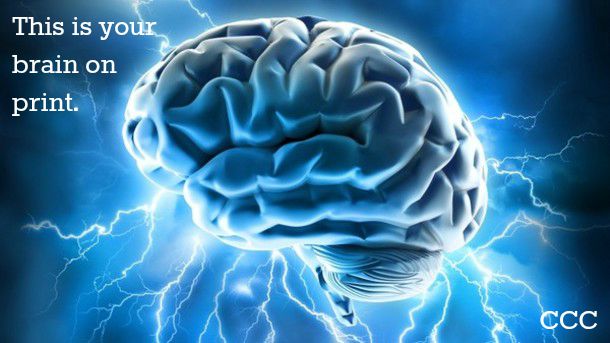
A week later, subjects showed greater emotional response and memory for physical media ads
Physical media caused more activity in the ‘purchase intent’ area of the brain
We’re not telling you to ditch digital. In fact, print is even more effective when combined with your digital efforts. Send a direct mail piece with a personalized URL (PURL) to your recipients, so they can go online and respond or buy quickly and conveniently. Utilize a QR code and text short code on a handout at an event, so attendees can request an electronic version, answer survey questions or enter to win a contest on their phone while they’re still in the room.
The Temple University study highlighted a key takeaway. Effective print ads will drive digital purchases. So even if the C-Suite prefers flipping through a physical catalog, they’ll probably place an order online. Make sure that you devote enough time to your website design and checkout process. You don’t want a disastrous digital experience to interrupt the steady stream of leads — and sales — that print will bring to your door.
The Power of Print in Your Marketing Efforts
Do you utilize print in your marketing efforts?
Do you see your brand increasing, decreasing or holding steady in its print usage in the short-term?
How can you integrate the power of print with your digital marketing efforts?
Share a powerful print example that moved you or someone else to make a purchase.




















 clearly conveyed communications