CCC is excited to accept its second award for this blog — The Butterfly Light Award — from Sage Doyle, author of The Journal of Wall Grimm and guest blogger extraordinaire.Thanks, Sage!
This award is given to those who are using their blog to spread light or be a positive influence in today’s world. We’re honored to accept this award, because we’re big believers in helping others, bringing a smile to people’s faces and Paying It Forward. With every post, we’re aiming to help business professionals and small business owners with their marketing, writing and social media efforts while also reflecting on life, lessons learned and what moves us as human beings. If one person walks away from reading a post with more knowledge, an idea for her business or a smile on his face, we’ve done our job. If we’ve accomplished one of these goals with you, please chime in and let us know about it! What post(s) or type of post(s) are your favorite?
Now comes the hard part: choosing who we will bestow this award upon. We appreciate the entire CCC community for your loyal reading, continuing the conversation with your keen insights and comments and sharing our posts with your networks. When thinking about what this award stands for, one reader quickly came to mind.
Rich is a small business owner, volunteer firefighter, husband and dad. He and his wife, Lisa, are blessed with two great kids, including Mattie, who has Down Syndrome. The family is active in promoting Down Syndrome awareness and supporting the Special Olympics. As a volunteer firefighter of 30+ years, Rich has been involved in numerous fundraisers, charity benefits and helping out those in need. He’s truly one of the good guys, and we’ve thoroughly enjoyed working with him for the past year. Congratulations Rich, you deserve it!
Rich and Mattie hang out at Mattie’s favorite place — the fire station. Mattie wants to be the first firefighter with Down Syndrome. Go, Mattie! (Photo courtesy of Rich Mistkowski)
“I’m blessed to have Mattie as my son. “It never ceases to amaze me about the impact that Mattie has on people. He seems to be able to bring something out in people that I’ll never understand, but always marvel at.” –Rich Mistkowski
Thank you to Belinda for creating this award to promote positivity and helping others.
Cheers,
Jaime
Help us spread light by connecting with CCC online:
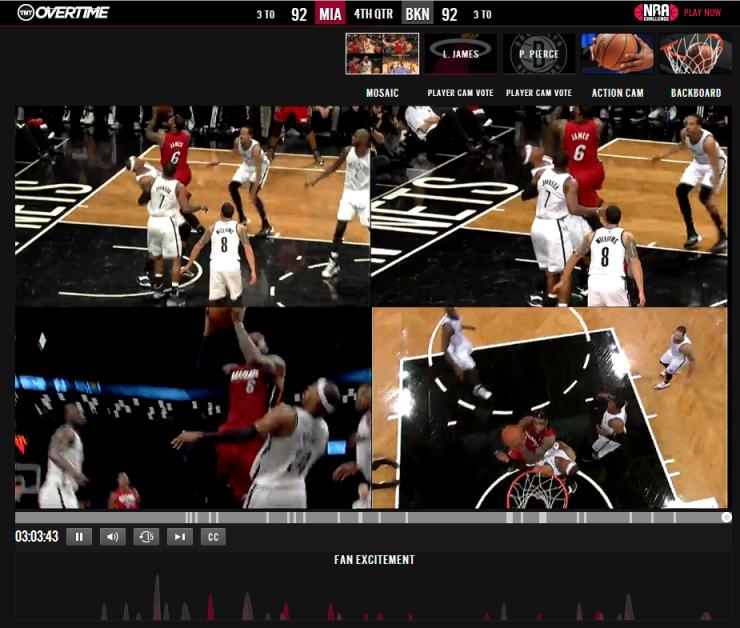
As I sit here and watch the conclusion of the Nets-Heat game, my thoughts keep drifting back to my business. It’s not for lack of excitement: this game, and especially the 4th quarter, has been a back-and-forth affair. In fact, I’m loving the view on TNT Overtime:
Wouldn’t it be great if you had this type of dashboard for your business? I’m not talking about social media software but an overall sneak peek into the state of your business. Cameras focusing on different areas — key clients, where the action is, your cash flow, etc. — along with measuring fan excitement and the overall score. Oh, and the ability to pause (vacation, anyone?), rewind (eliminate a mistake before it happens) and fast forward (through a crappy day). Hey, I can dream, right?
While we don’t have an omnipresent dashboard view of our businesses, we do have resources at our disposal. This week is National Small Business Week, celebrated annually every year since 1963. If you’re an entrepreneur or small business owner, check out the following ways you can participate:
According to the U.S. Small Business Administration, more than half of Americans either own or work for a small business, and they create about two out of every three new jobs in the U.S. each year.
Whether or not you’re a small business owner, you can help! We can all shop small, and not just one day or week a year. Visit the Shop Small Map to check out dining, shopping, entertainment and other small biz options in your community or search online. (Social media is a great tool to search and gather feedback on small businesses you find.) As Business News Daily points out, it’s National Small Business Week, and you (yes, you!) should care.
Well, the game’s over (Heat won!), the tornado warning has expired and the flash flood warning is winding down. I guess I should wrap up this blog post; I’ve got a client meeting early this morning (before you’ll even read this post). Crank up the espresso machine…
How are you celebrating Pay It Forward Day 2014? Pic credit: PIF Experience
Happy International Pay It Forward Day 2014! While we’re all better off paying it forward regularly, having an official day helps bring attention to this worthy movement.
So what is the Pay It Forward movement all about? Watch this TEDTalk by Charley Johnson, founder of the official group behind the global Pay It Forward movement and head of the Pay It Forward Foundation.
Are you inspired?
Here’s some of the ways that CCC pays it forward. How are you paying it forward in your community (or around the world)?
It’s amazing what thousands of little Lego pieces can create!
I’m onsite with a client this week and have been reminded of an important adage as I delve into the company’s processes and systems.
It’s all about the little things.
It really is. The smallest pieces of data, minor decisions and ‘mundane’ moments make up most of our lives. If we learn to appreciate these seemingly irrelevant aspects of our being, we’ll be a lot better off. Processes will go smoother, relationships will work better and we’ll get more enjoyment out of life.
For example, I headed to the Mall of America while I’m in town and had to visit the Lego Store. Its impressive display on top of the store (pictured above) is amazing! Think about the thousands upon thousands of little Lego pieces it took to make this eye-catching display. If one piece was missing or the wrong color, it would stick out. Every single piece contributes to the finished product — a work of art.
This thought process applies to your business life too. Emails, reports and other communications help ensure everyone is on the same page when working on projects. The smallest pieces of data add up to provide crucial demographic information and reports showing return on investment. Branding, events, marketing, promotions, social media and sponsorship can all go right or wrong based on the most minute of details. Every part of the process, no matter how small, is necessary to achieve the desired end result.
So pat yourself on the back for a job well done the next time you take care of the little things.
Sound Off
What little things do you take care of?
How has handling a little thing led to a big moment in your life?
p.s. Have you been to the Mall of America? What’s your favorite part?
As I sat on a plane last week thinking about blog topics, I realized that the CCC blog has never delved into business travel. Despite the Great Recession, business travel remains a popular way to close deals, educate people and cement/maintain crucial relationships. I used to travel for business more than I currently do, but I have spent the better part of the past two weeks on the go.
My view — from 35,000 feet.
Here are some tips I’ve picked up from my travels over the years:
Know where you’re going. Does your hotel have a pool or workout facility? Continental breakfast? Free WiFi? A Keurig in the room? With a little forethought, you can be prepared to take advantage of these amenities and save yourself time and money. Are you familiar with the area? Will you need to entertain clients? What restaurants or entertainment is available? When/where is your meeting? Are you attending or presenting at an event? What’s the time difference? Have all of the details on you, so you can alert necessary parties if travel disruptions cause a rift in your schedule.
Know how you’re getting there. Have ALL of your travel info (airline info, itineraries, special policies, hotel confirmation, rental car confirmation, driving destinations, routes, airline, hotel & rental car contact info, etc.) in one place and easily accessible. Electronic copies are great, but it helps to have printed copies too. If any problems arise, you’ll have confirmation of your reservations and can easily contact the appropriate parties.
Know who you’re meeting with. Whether you’re attending or presenting at an event or meeting with clients, do some research. What’s the dress code at your event or client’s office? It’s helpful to understand a client’s corporate culture if possible for meeting purposes and to ensure a successful, long-term relationship. What’s your client’s gift policy? You may think you’re being nice by bringing a special something to leave behind, but it may make for an awkward situation if your contact can’t accept it. If you’re at an event, are there other opportunities to do business or is it not appreciated (or flat out prohibited) by management? Don’t start off on the wrong foot by making an innocent mistake that could lead to major consequences.
Plan for the worst; hope for the best. Sh%@ happens. We all know that but expect everything to run smoothly all of the time. If at all possible, don’t take a last minute flight to your conference. If it’s delayed or even canceled, you’ll have time to reroute to the conference before it begins. If you’re driving, allow for extra time in case you hit traffic or encounter construction. You may get lost, not be able to catch a cab or find out your hotel room reservation was lost. Obviously it’s not always possible to allow extra time, but oftentimes we (as human beings) put everything off to the last minute and cause a lot of our own stress.
Track your expenses. Whether you’ll need to fill out an expense report or are a small business owner, it helps to track your expenses. You can see where unexpected expenses pop up and may be able to plan to eliminate or reduce these on future trips. For example, if you find yourself consistently buying bottled water, try to pack a refillable (and even folding/collapsible) water bottle.
Conduct a post-trip analysis. Take a few minutes to analyze your trip when you return home. It’s really helpful to keep a small notebook to jot down ideas and feedback in real time during the trip. Were you surprised by an airline policy? Did you find a hotel that’s in a better location? Did an audience member suggest a presentation change? Did you notice something during your event that you could do differently next time? Write it down so you can look into it further or implement changes for future travel.
Keep the essentials in your carry-on! Losing your luggage is terrible, but it doesn’t have to sideline your trip. (No, guns aren’t allowed in carry-ons and even gun-shaped hot packs may cause a stir.)
Helpful packing tips:
Wear the same clothes on travel days. If you’re going to be working in airports, sitting on planes, setting up your booth, etc., save room in your suitcase.
Coordinate clothing so that you can mix and match. You may be able to stretch two pairs of pants over three or four days with different shirts.
Pack (mostly) healthy, on-the-go snacks. Sometimes it’s difficult to find time to eat (especially at events), so try to have almonds & dried cranberries, fruit snacks, granola/protein bars and a refillable water bottle on hand. Grab some apples, bananas and other fresh fruit for your room from the continental breakfast.
Stuff shoes full of socks, undergarments and accessories to save space.
Roll shirts, workout gear and other items to save space. Pants may fit better folded in a specific location.
Put event credentials, medication, chargers and any other crucial items in your carry-on. A change of clothes is helpful too if it fits.
Take advantage of outside pockets, interior compartments, specialty niches and any nooks & crannies in your luggage. A little planning while packing goes a long way!
Leave room for swag bags, samples and literature you’ll be picking up at a show unless you plan on shipping these items back. (Depending on baggage policies, it may be advantageous to ship these items. Take advantage of any onsite or show specials in this area.)
Wear slip-on shoes and simple clothes (free of embellishments, metal, etc.) to the airport. It’ll help you breeze through security and save time and a lot of frustration.
Know where your liquids (in zip bags) and electronics are in your carry-on, so you can remove them for security quickly.
Your Turn
What other travel or packing tips have you picked up along the way? Chime in and help everyone do business a little easier on the road.
The evidence is in, and there can be no doubt. Treating employees well and making them happy affects the bottom line. Let’s explore the dynamics, and see just how to achieve a kinder workplace and happier employees.
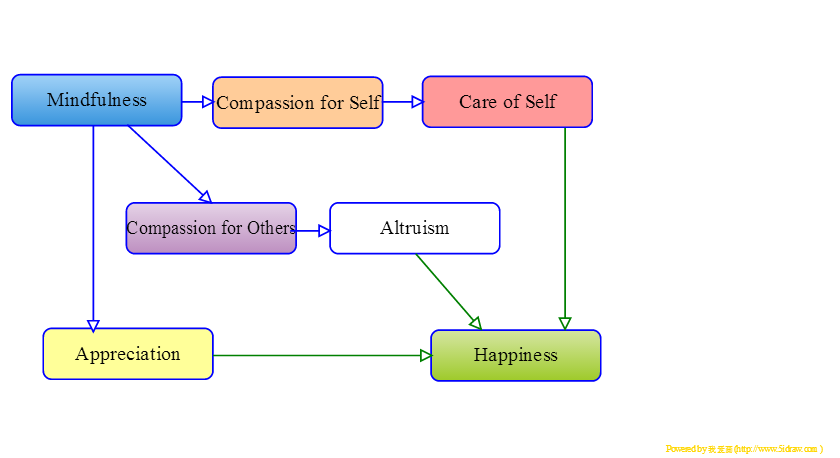
This “happiness map” is a generic guide to happiness. Nevertheless, it is as relevant in a workplace setting as anywhere else.
This way to happiness >> Happiness Map by Carol Preibis
Notice that the starting point is “Mindfulness.” Being mindful promotes compassion (kindness). Mindfulness also leads to “Appreciation” — it teaches us gratitude. Conclusion: To achieve happiness in the workplace, we would do well to:
Apply mindfulness to the workplace.
Foster gratitude across the organization.
Mindfulness
“SAKURAKO – Pick up the phone.” by MIKI Yoshihito via CCBY2.0
“Mindfulness is a way to live your life as if it really mattered. And that involves being in the present moment with open-hearted presence and kindness toward yourself.” — Jon Kabat-Zinn
Evidence suggests practicing mindfulness can help organizations by diminishing stress-related health care costs and increasing productivity. Kelley McCabe Ruff runs eMindful, a Vero Beach company that puts on virtual workshops for businesses. She has been able to quantify the effectiveness of eMindful’s programs, showing that they support behavioral change that leads to physical changes, such as reduced cortisol levels and lower blood pressure. “We actually supply employers a return on investment calculation.”
Kelley McCabe Ruff, eMindful CEO and founder, relates eMindful’s focus on reducing employee health care costs and increasing productivity. Live programs are offered via the internet, allowing eMindful to provide the most experienced and expert teachers in Mindfulness as well as other Mind-Body Programs. Presented by eMindful – http://www.eMindful.com
Reflecting before reacting is the first step in practicing mindfulness, and learning it is quite simple. Think of the acronym STOP:
Stop —Stand orSit Take a breath Observe Present – be in thepresent moment
Rhonda Magee explains the technique in this video.
Rhonda Magee, JD, is Professor of Law and Co-Director of the Center for Teaching Excellence at the University of San Francisco. In this talk from the “Practicing Mindfulness & Compassion” conference on March 8, 2013, Magee explores how to apply contemplative practices to our professional lives–and in doing so create more compassionate workplaces.
Sharon Salzberg, author of the book Real Happiness at Work: Meditations for Accomplishment, Achievement and Peace, believes mindfulness can be applied in any career. “It’s a great tool for coming back to the moment and remembering your intention,” she says. For example, practicing mindfulness at work could be pausing and planning before picking up a phone, or taking a deep breath and focusing on the desired outcome during a contentious meeting.
“Teaching and encouraging mindfulness in the workplace has become a part of corporate efforts to reduce the stresses that can lead to burnout. Increasingly, the practice has gone mainstream, buoyed by the recent endorsements of CEOs, educators, actors, and politicians who link mindfulness to improved psychological and even physical health.” ― Cindy Krischer Goodman, Working with ‘mindfulness’ reduces stress in the workplace
Gratitude
“Good Job on Sticky Note” by David Castillo Dominici via FreeDigitalPhotos.net
“To practice gratitude, we must practice mindfulness. When we are truly present in the moment, we see the beauty all around us. And the more joy we cultivate, the more we can practice our purposeful awareness and acceptance of the present moment. Mindfulness begets gratitude, gratitude begets mindfulness.” —Sarah RudellBeach,Mindfulness and Gratitude: A Celebration of Thankfulness
Foster an environment of gratitude across your organization. Gratitude in organizations is important—it can boost morale and increase productivity. To learn more about this dynamic, theGreater Good Science Centerdeveloped aquiz that measures the level of gratitude in an organization. An analysis of the results concludes: “In order to foster gratitude across an organization, it may help to maximize opportunities for people in low-level positions to make meaningful contributions, and ensure that their contributions are recognized—especially for employees who have been in a low-level position for many years. It may also be wise for organizations with high levels of stress to bring more awareness to how often—and to whom—expressions of gratitude are granted.”
A wonderfully effective way to recognize employee contributions is with an “office gratitude journal.” The Administration and Finance office of the University of California, Berkeley, created an appreciation platform that allows employees to recognize each other’s contributions, which feeds into a “Kudos” webpage that publicly highlights these contributions. A simpler and equally effect implementation of this same idea is a bulletin board known as a “wall of gratitude.” For details on these and other suggestions, see five ways to boost gratitude at work.
Kindness
“Business Team Discussing Ideas” by stockimages via FreeDigitalPhotos.net
“This is what I find most magnetic about successful givers: they get to the top without cutting others down, finding ways of expanding the pie that benefit themselves and the people around them. Whereas success is zero-sum in a group of takers, in groups of givers, it may be true that the whole is greater than the sum of the parts.” ― Adam Grant, Give and Take: A Revolutionary Approach to Success
There are so many ways to bring kindness into work. Here are a few suggestions:
Be friendly! Smile, give a compliment, speak a few kind words. Bring in a treat to share.
We all understand the importance of work-life balance. A booklet from Acas Publications offers expert advice on work-life balance and flexible working. It includes some real-world problem scenarios, and provides real-world solutions.
Employee Engagement
Photo credit: betterworks.com
“To win in the marketplace…you must first win in the workplace. I’m obsessed with keeping employee engagement front and center.” — Doug Conant
Employee engagement is crucial to the success of any organization, and it is management’s responsibility to make it happen! Managers, consider these tips:
Give your employees autonomy. Let them know what’s going on, and elicit their ideas for improvement.
Transparency is important to employees. Share long-term visions. Explain how their work fits into the big picture.
Give employees opportunities for growth. Offer them new responsibilities. Give them time to train and learn.
Employees love feedback, so give it often. If you have recommendations for improvement, offer to help them implement them.
Be nice! Let them know that you care about them as people, not just as employees.
It’s inspiring to think about individual pay it forward chains. It’s even more amazing to picture pay it forward webs. Each person in a chain has opportunities to fire off new chains. Most people are in multiple chains. Perhaps a web might look like a Tinker Toy project!
“Tinker Toys for Adults” by greenmelinda via CCBY2.0
“The best part of life is not just surviving, but thriving with passion and compassion and humor and style and generosity and kindness.” —Maya Angelou
The time is right. These ideas are becoming mainstream, and for good reasons. It’s an exciting time for all of humanity. Be mindful, be grateful, be kind. Watch kindness spread from heart to heart and share the joy, especially in the workplace.
This is part two of a two-part series, Kindness in the Workplace, by Carol Preibis of Ahh The Simple Life. If you missed part one last week, please click here. For more on Carol, keep reading. Thanks, Carol!
Carol is passionate about food, recipes and cooking.
Carol Preibis and her sister Michele value the Simple Life and want to help you shed the complicated nature of today’s world. They share insights on food, decorating, stress relief and living more simply, while actually enjoying day-in, day-out living. [UPDATE: Their blog, Ahh the Simple Life, is no longer active.]
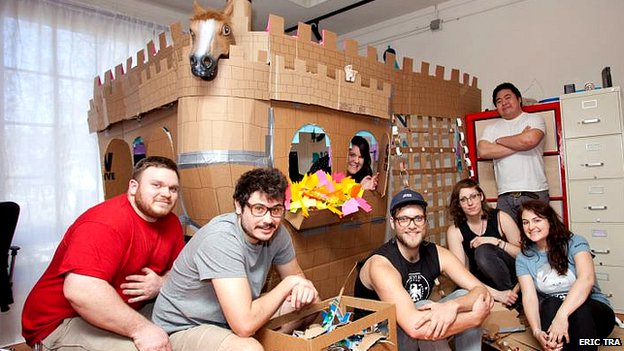
Killer Infographics thinks it’s important for their workers to be happy, and they’re encouraged to have fun. Photo credit: KillerInfographics.com
Why Kindness Is Important
Kindness is important everywhere, and the workplace is no exception! The power of kindness is extraordinary. But when we talk about the workplace, there are some important additional reasons why kindness is so vital.
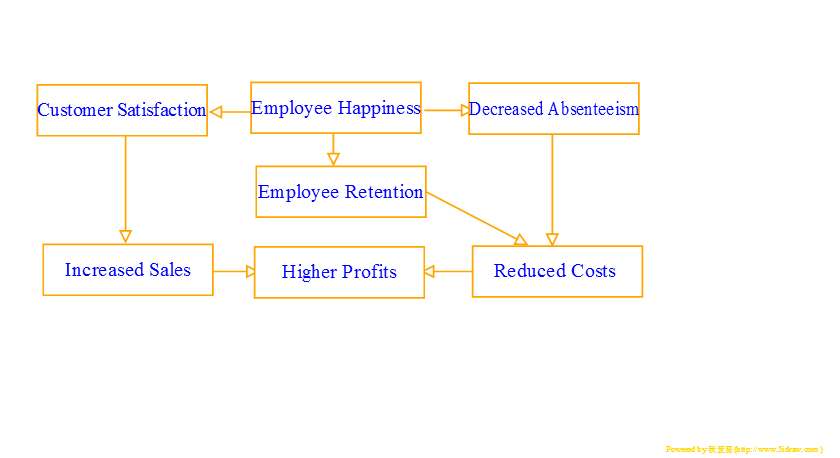
Treating employees well and making them happy affects the bottom line. As shown in the diagram below, employee happiness increases profits three ways:
By increasing customer satisfaction, and thereby increasing sales.
By decreasing absenteeism, and thereby reducing the costs associated with absenteeism.
By improving employee retention, and thereby reducing the costs associated with replacing an employee.
Workplace Kindness Map By Carol Preibis
There are numerous research studies to support this model.
employment engagement
Photo credit: betterworks.com
Dr. Noelle Nelson is a clinical psychologist, business trial consultant, and best-selling author of Make More Money by Making Your Employees Happy. In her book, Nelson cites a study from the Jackson Organization, which shows, “companies that effectively appreciate employee value enjoy a return on equity and assets more than triple that experienced by firms that don’t. When looking at Fortune’s ’100 Best Companies to Work For,’ stock prices rose an average of 14% per year from 1998-2005 compared to 6% for the overall market.” Dr. Nelson explains, “When employees feel that the company takes their interest to heart, then the employees will take company interests to heart.”
Photo credit: Kevin Kruse
absenteeism
The American Psychology Association tells us that stress is a major cause of illness today, and often workplace stress is the primary cause. This contributes to workplace absenteeism, which causes considerable direct and indirect costs to businesses. According to awhite paper from Circadian, “A company of 5,000 hourly employees has the potential to reduce costs by over $7.9 million per year, or 3.2% of total payroll.”
employee retention
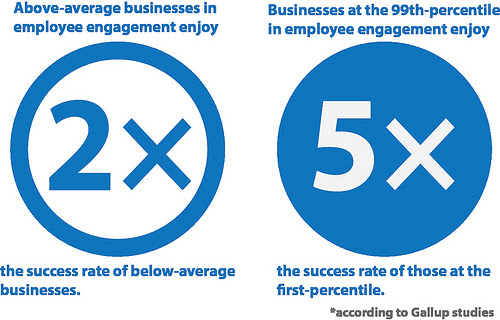
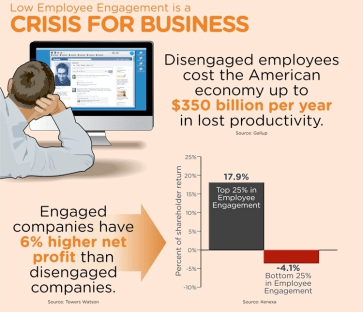
Awhite paper by the Kenexa® Research Institute reveals that organizations with highly engaged employees achieve twice the annual net income of organizations whose employees lag behind on engagement. Their conclusion: “It is clear that properly-fitted leadership practices give rise to an engaged workforce—a workforce positioned to deliver the organization’s customer value proposition. Loyal customers lead to market share gains, greater profitability and long-term success.”
Are You Listening?
Listen.
In every office
you hear the threads
of love and joy and fear and guilt,
the cries for celebration and reassurance,
and somehow you know that connecting those threads
is what you are supposed to do
and business takes care of itself.
Someone needs to say “amen”.
CCC is honored to host this 2-part series on the value of kindness in the workplace written by Carol Preibis. Part 2 will focus on how businesses can achieve a kinder workplace and enjoy the benefits mentioned in this post. For more on Carol, keep reading.
Carol is passionate about food, recipes and cooking.
Carol Preibis and her sister Michele value the Simple Life and want to help you shed the complicated nature of today’s world. They share insights on food, decorating, stress relief and living more simply, while actually enjoying day-in, day-out living. [UPDATE: Their blog, Ahh the Simple Life, is no longer active.]
Every time I hear the word tweetup, this classic dances into my head.
What’s a tweetup? It’s a face-to-face meeting of people who are on X/Twitter. That’s it. The concept is simple, but it’s not always easy to pull off. If you’re thinking about holding a tweetup at your next event, keep these tips in mind:
At a tweetup? Have fun and talk to people!
Location, location, location. Just like in real estate, it’s all about the location. Pick a spot that can accommodate the expected number of attendees and is accessible, but not in the main drag, so to speak. If everyone’s already in the lobby or at the hotel bar, then don’t hold your tweetup there. It will be too difficult to figure out who’s at the tweetup and who’s just hanging out there. (p.s. It’s helpful to pick a location with strong phone service and/or Wi-Fi so people can actually tweet at your tweetup.)
It’s all about the plan. It may seem like everyone just shows up, but that’s not the case — especially if you want everything to run smoothly. Besides scouting the location, you need to figure out the other aspects. Prizes and special guests will help draw a crowd, while hors d’oeuvres or snacks will be appreciated. You can also have a theme for your tweetup; raise money or collect canned goods for a cause, or tie it to your overall event (i.e., recharge at your tweetup at a racing-themed event with snacks, seating areas & phone chargers)
Hello, my name is… Yes, you’ll probably have some type of badge or name tag if you’re at an event, but it won’t showcase your Twitter handle. Remember, Twitter handles aren’t always people’s names, so it’s helpful to have name tags (and pens/markers) for people to write their handles on. It also gives attendees something to do when they first arrive and serves as an ice breaker. You can design a custom template for your event or offer different colors of name tags to differentiate between attendees (i.e., green for exhibitors, blue for staff). Whatever route you go with the name tags, make sure you can see the Twitter handles. That’s what you’re there for!
Tweet about it! Let people know the tweetup will be happening and then fill in the details once they’re available. You don’t have to promote the exact details too far in advance, either. In fact, some people wait until the night before or the morning of the tweetup to tweet the exact time and location. Keep other promotions to a minimum. A tweetup is specifically for people on Twitter, so there’s really no need to promote it on Facebook or Instagram (that’s an InstaMeet, anyway). On-site promotion isn’t necessary either. While you need people to find the location, you don’t need to attract interest from the passing traffic. (p.s. Creating a specific hashtag is your call. If you already have an event hashtag, it may only cause confusion.)
The tweetup day’s here! Arrive early to make sure everything’s ready to go and begin welcoming your Twitter followers. Introduce yourself to attendees and remind them about the name tags and snacks, along with any prize giveaways or special guests. Encourage them to check in at your tweetup or tweet pictures and updates.
Have fun! You’ve done the work, now enjoy yourself. Go beyond 280 characters, and get to know attendees beyond their Twitter handle. One last thing… don’t forget to stop tweeting long enough to actually talk to the people in front of you. 😉
Tweet about it
Have you attended or organized a tweetup?
What tips would you add? Is there anything you tried that did not work?
A ripple. It’s not much by itself. But it’s amazing what happens as more and more ripples gather together: they cause change. Whether you’re trying to make the world a better place, become healthier or advance your career, small acts and minor decisions do matter.
Enough ripples can become a tidal wave.
We love dramatic reveals after makeovers, watching contestants reshape their bodies on the Biggest Loser and seeing people use a financial windfall to do good. The only problem is that these situations aren’t relevant for 99% of us, so we feel helpless.
But we can make a difference — in our own lives, our communities and even the world. The key is to make small changes and commit small acts. They’re sustainable, we can incorporate them into our lifestyles and they add up to make a big difference.
What if every person recycled one plastic bottle a month? Would our landfills be lighter? What if you replaced one sugary drink with a glass of water daily? Would you be healthier? Think about this: If you replace one 12 oz can of soda with water every day, you’d save 51,100 calories a year and lose about 15 pounds. (Source)
It goes beyond your physical health. Has someone made your day recently with a small act of kindness? Maybe they held the door when your hands were full or let you pull out during the busy commute home. Or perhaps a co-worker brought you a coffee one morning or a friend made a minor repair to your car. Isn’t the power of kindness amazing?
Apparently, it doesn’t just make us feel warm and fuzzy inside. More and more evidence points to kindness actually making us healthier in a number of ways.
At CCC, we’re big believers in the Pay It Forward movement and try to make a difference every day. We’re not making million dollar donations or ending poverty (we wish we could), but we are saving lives by donating platelets and volunteering our time and talents.
What small act are you committing to make a difference in your own life or your community? Share your thoughts and stories in the comments below to help inspire others to join the movement and make our world a better place.
p.s. Need a reason to smile? Search the #PayItForward or #UNselfie hashtag on your favorite social platform to read about the good going on in the world. (Add your own story!)
Writing. It’s something we all learned to do at an early age, but some people are more adept at it than others. If you’re trying to improve your writing, here are a few tips I’ve picked up since I started writing at age 3. 🙂
I still love filling notebooks with my thoughts and chicken scratch.
Write often. Then write some more. It’s amazing how much more confident you feel about your writing when you practice, practice, practice. Blogging, notebooks, a journal or your Mac, the platform and audience doesn’t really matter. Just keep writing.
Can’t write? Read. Even if you’re not an avid reader, find something — or someone — you like. It doesn’t have to be business-related or in your field. As much as I enjoy psychology and sociology books, my favorite author of all time is Stephen King, a master of words. I’ve learned so much from reading his works.
“If you don’t have the time to read, you don’t have the time or the tools to write.” –Stephen King
Say something. Seriously. Read what you just wrote and ask yourself what the takeaway is. If you can’t come up with anything, then neither can your audience.
Don’t waste words. While the type of writing depends on your audience, platform and objectives, never waste words. If a word or paragraph doesn’t add anything to your work, leave it out. Being eloquent doesn’t have to mean being wordy.
Dot your i’s and cross your t’s. Proofreading isn’t optional, even in the era of instant publishing and smartphone communication. Poor spelling, grammar and punctuation reflects poorly on the author, no matter what platform. It’s usually helpful to have others proofread your work, but if that’s not possible, at least try to walk away for awhile. It’s amazing what fresh eyes can see.
So grammar’s not important, huh? Photo credit: Writers.com (h/t Kathy Yoho)
Beat writer’s block. It happens to anyone who writes sooner or later, but there are actions you can take. Get moving. A brisk walk, an energetic game of basketball or an afternoon hike can be just what you need. They also draw your attention elsewhere. Sometimes when you try so hard to think about something, your brain locks up. It’s not a coincidence that so many great ideas, from novels to solving a client’s issue, happen in the shower or during a run. Think about something else, and the words will probably start flowing again.
Carry a notebook. While I’m old school and love to fill notebooks with my chicken scratch, you may prefer the digital domain. Either way, always carry a notebook (even if it’s your smartphone). You never know when, or where, an idea will strike.
Write to your audience. It’s helpful to know who your audience is so you can write to them. Speak in their language, play to their interests and use words they understand. Have you ever read something that seemed like it was written just for you? That’s the power of writing to your audience.
Pay attention. The world is full of writing topics; you just have to see (hear, smell, feel or sense) them. Pay attention to your surroundings, even during mundane tasks. You’ll be surprised what can come out of a walk in the park or your daily commute. I’ve had ideas for blog posts pop into my head while driving through a local metro park and making leg lamp cookies.
What tips would you add?
Where’s your favorite place to write (or read)?
Have you ever read writing outside of your ‘comfort zone’ and loved it?
While we’re all expected to be writers these days, some people just aren’t comfortable putting their thoughts on paper (or screen). Is that you? Then I’d love to work my magic for you.